
Effects of Wiring and Connection on Power Supply Performance
Power supplied from standard AC outlets often contains noise, momentary voltage drops, and harmonic distortion. To ensure stable operation, DC power supplies are used to regulate voltage and minimize noise. However, even with a high-performance power supply, improper wiring can degrade output quality, cause malfunctions, or lead to safety hazards such as overheating and fire.
Two main factors in wiring significantly impact power supply performance:
Wiring Resistance and Impedance
Every wire has internal resistance, inductance, and capacitance. While these values may seem negligible, they can become significant in precision applications.
- Voltage Drop: High resistance in thin or long cables causes a voltage drop between the power supply and the load.
- Heat Generation: Excessive resistance can lead to cable heating and potential fire hazards.
- Response Issues: Parasitic inductance and capacitance can degrade the power supply's transient response, leading to unstable output or measurement errors.
- Contact Resistance: Loose or corroded connections increase contact resistance, further degrading performance.
Noise Susceptibility
Long wiring can act as an antenna, picking up electromagnetic interference (EMI) from surrounding equipment.
- External Noise: Wires may pick up surges and radio frequency (RF) noise, affecting connected devices.
- Common Impedance Coupling: Long ground wires often create common impedance, where current from one circuit affects the voltage reference of another. To mitigate this, use thick, short wires and separate signal grounds from power grounds.
There is also the problem that longer wires are more likely to generate common impedance noise. Common impedance exists in the common part of multiple circuits, and it is a phenomenon in which the operation of one circuit affects the operation of another circuit.
In order to avoid the common impedance, the wiring needs to be thicker and shorter. Other sources of noise caused by looping excess wires and bundling power cables can badly affect the performance of the power supply unit.
Three Key Guidelines for Proper Wiring
To minimize resistance and noise interference, observe the following guidelines when connecting loads and controllers.
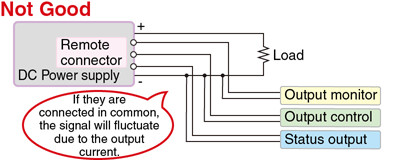
(1) Separate Grounds for Power and Control Signals
Do not daisy-chain or share a common ground line for power output, analog remote control, and digital control signals. If these grounds share a single wire, the fluctuating current from the power output can shift the ground potential for the control signals (Common Impedance Coupling). This often results in "Common Mode Noise," causing communication errors or unstable control. Always wire grounds separately to a single reference point (Star Grounding) where possible.
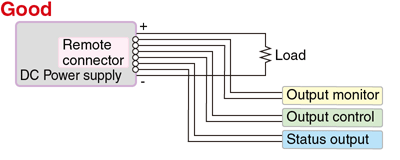
(2) Minimize Wiring Length
Keep all cables--power, sensing, and control--as short as possible. Excess length increases resistance and inductance, making the system more susceptible to noise and voltage drops.
(3) Route Signal Cables Away from High-Frequency Sources
Control wiring acts as an antenna for high-frequency noise.
- Avoid routing remote control or USB cables near high-frequency power sources or switching power lines.
- For USB connections, use high-quality shielded cables and keep lengths well under the 5-meter standard limit in noisy industrial environments.
- Optical Isolation: In factory environments with high electrical noise, consider using optical fiber cables and optical isolation adapters to completely eliminate electrical noise propagation.
To prevent trouble, ensure the wiring for remote control should not pass near high-frequency power sources.
And using optical fiber cables instead of electrical cables is another countermeasure against the malfunction of the digital remote control.
For example, in noisy environments such as factories or when remote control at long distances is required, there will be no electromagnetic or common mode noise using an optical isolation adapter.
Understanding Cables and Cords
While the terms "cable" and "cord" are often used interchangeably, there are distinct differences in their construction and intended application.
Basic Differences
- Cable: Typically refers to a durable assembly of one or more insulated conductors, often with a tough outer sheath. Cables are designed for fixed installations, structural wiring, or harsh environments requiring high durability and noise immunity.
- Cord: Generally refers to flexible, stranded conductors used for temporary connections or connecting appliances to outlets. Cords prioritize flexibility over long-term structural durability.
Selecting the Right Type
For industrial power supply applications, selecting the correct wire type is crucial for safety and signal integrity.
- Power Supply Wiring:
-
Use heavy-gauge cables with appropriate insulation (e.g., Cross-linked polyethylene or Vinyl Cabtire) to handle high currents and environmental stress.
- Underground power transmission cable
- Cross-linked polyethylene insulated wires for outdoor use (OC)
- Cross-linked polyethylene cable (CV)
- Vinyl cabtire (VCT) cable
- VCTF cable
- Indoor PVC
Apart from the above-mentioned cables, bare wires that have no insulation around the conductors are used as transmission lines to supply high-voltage electricity from power plants.
- Signal & Control:
-
Use twisted-pair or shielded cables (e.g., CVV or Optical Fiber) to protect sensitive signals from external noise.
- Control-use Vinyl insulated vinyl sheathed (CVV) cable
- City pair polyethylene insulated PVC sheathed (CPEV) cable
- Optical fiber cable
- Safety Critical:
-
For fire alarms or emergency systems, use fire-resistant (FP) cables designed to maintain circuit integrity during a fire.
- Fireproof (FP) Cable
- FP-C Cable
- Fire Resistant Cable
Reference (Japanese site)
- オムロン - パワーサプライの入力や出力の配線はどのように処理すればよいですか?
(https://faq.fa.omron.co.jp/tech/s/article/faq01931) - ノイズ対策.com - 共通インピーダンス
(https://www.noise-counterplan.com/glossary/1261/)
Recommended products
Matsusada Precision manufactures and sells various types of power supplies.