


Characteristics of Electric Double-Layer Capacitors (EDLCs)
Unlike conventional capacitors, Electric Double-Layer Capacitors (EDLCs) offer significantly higher capacitance. This is achieved by forming an electric double layer at the interface between the electrode and the electrolyte. Similar to standard capacitors, EDLCs exhibit excellent high-current charge/discharge performance and durability over repeated cycles. Their key features include:
- Long Cycle Life: Capable of millions of charge/discharge cycles with minimal degradation.
- High Power Density: Enables rapid charging and discharging.
- Environmentally Friendly: Electrodes are free from hazardous substances like lead and cadmium.
- Wide Temperature Range: Operates reliably in diverse environmental conditions.
Due to these characteristics, EDLCs are often used in conjunction with batteries, such as in electric vehicle powertrains. Placing an EDLC between the inverter and the battery allows the system to handle high-power peaks during acceleration and regeneration, reducing the load on the main battery.
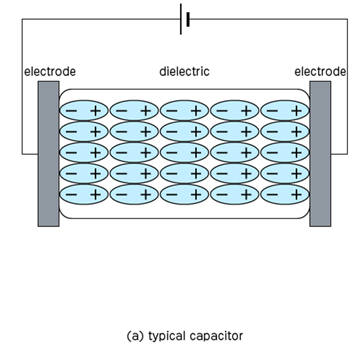
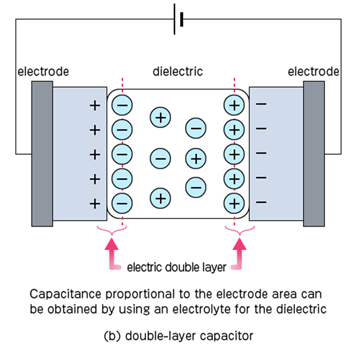
Typical EDLC cells are rated around 2.5 to 2.7 V. To achieve higher voltages, multiple cells must be connected in series. For increased capacitance, cells are connected in parallel.
When connecting in series, voltage imbalance can cause overvoltage on individual cells. Therefore, a cell balancing circuit (often using voltage-dividing resistors) is essential to ensure safe and stable operation.
Recent advancements in activated carbon technology have led to electrode materials with massive specific surface areas (approx. 2000 m2/g), further increasing energy density. In cylindrical EDLCs, which are optimized for mass production, electrical characteristics such as capacitance and internal resistance (ESR) depend on the electrode thickness, manufacturing method, and the specific combination of activated carbon and electrolyte.
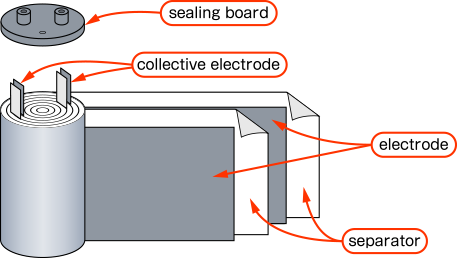
Regarding electrical characteristics, EDLCs differ significantly from rechargeable batteries. During discharge, the voltage of an EDLC drops linearly down to 0 V, making it relatively simple to estimate the state of charge based on voltage.
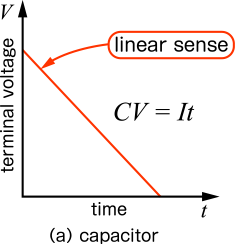
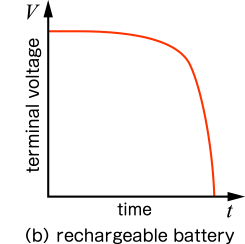
However, temperature characteristics must be carefully considered:
- Low Temperatures: Capacitance tends to decrease, and internal resistance increases.
- High Temperatures: Leakage current increases, which can accelerate self-discharge and reduce voltage retention.
Typical Applications of Electric Double-Layer Capacitors
EDLCs are widely used for load leveling, energy regeneration, and momentary voltage drop compensation.
1. Load Leveling (Peak Shaving)
EDLCs are ideal for smoothing fluctuations in power input and output. When input power exceeds demand, the excess is stored; when input drops, the stored energy is released to maintain a constant output.
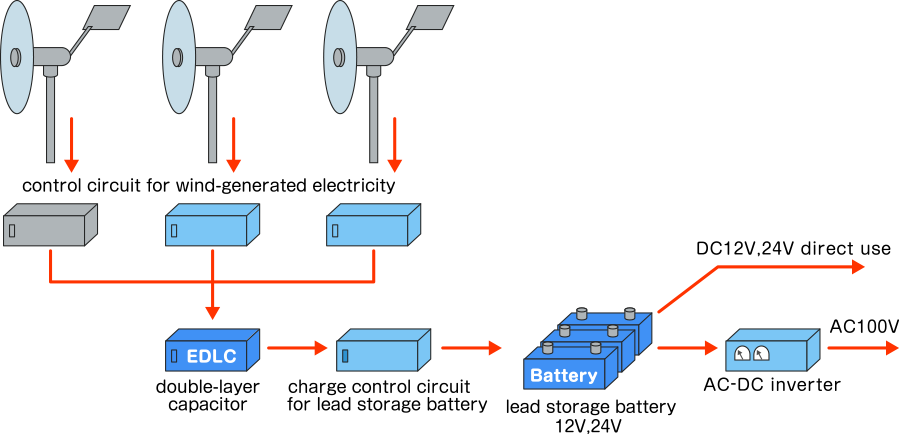
This is particularly effective for renewable energy sources like wind and solar power, which fluctuate with weather conditions. While bulk energy storage is handled by technologies like NAS batteries, redox flow batteries, or large lithium-ion arrays, EDLCs act as a rapid-response buffer. Since lithium-ion batteries often require controlled constant current/constant voltage (CC/CV) charging, erratic renewable inputs can be problematic. EDLCs can temporarily store fluctuating power and discharge it at a stable rate to the main battery system.
2. Energy Regeneration
EDLCs are excellent for capturing kinetic energy that would otherwise be lost as heat. In electric railways (like the Shinkansen) and hybrid vehicles, regenerative braking converts deceleration energy into electricity. Similarly, in industrial cranes, energy generated during the lowering of a load is stored in EDLCs and reused for hoisting. This significantly improves energy efficiency and reduces fuel consumption.
3. Momentary Voltage Drop Compensation
In facilities operating precision equipment--such as semiconductor factories or medical centers--even a momentary voltage drop (sag) caused by lightning or grid instability can result in system errors or damage. EDLC-based compensation systems can bridge the power gap instantly. If a long-term outage occurs, the EDLC maintains power long enough for backup generators to start up or for systems to shut down safely.
In summary, Electric Double-Layer Capacitors serve as critical power buffers, stabilizing power quality and enhancing efficiency across a wide range of industrial and infrastructure applications.
Related Technical Articles
Recommended products
Matsusada Precision's products for capacitor and battery


Reference (Japanese site)
- Japanese source page 「電気二重層キャパシタ(EDLC/スーパーキャパシタ)は電力を平準化する」
(https://www.matsusada.co.jp/column/edlc.html) - 「充電用電池の基礎と電源回路設計」トランジスタ技術SPECIAL2013 Winter, No.121
(https://shop.cqpub.co.jp/detail/1402/) - 名古屋工業大学 川崎晋司 「電気二重層キャパシタ」
http://kawasaki.web.nitech.ac.jp/jp/review/EDLC-SWCNT.pdf (non-HTTPS address) - 大容量キャパシタの現状と課題
(https://www.jstage.jst.go.jp/article/electrochemistry/74/3/74_3_249/_pdf/-char/en)