


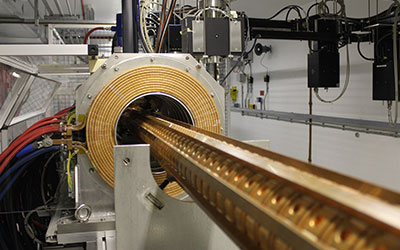
What is a Proton Beam?
Proton beams are a type of particle radiation generated by stripping electrons from hydrogen atoms to produce protons, which are then accelerated to high speeds. While proton beams are a form of particle therapy, they are generally distinguished from heavy ion beams (such as carbon ions). In Japan, "heavy ion therapy" typically refers specifically to the use of carbon ions, whereas proton therapy utilizes hydrogen nuclei.
What is a Heavy Ion Beam?
Heavy ion beams are a type of particle radiation consisting of nuclei heavier than protons or helium. In cancer therapy, carbon ions are most commonly used. A carbon ion beam consists of accelerated carbon nuclei--atoms stripped of their electrons--containing six protons and six neutrons.
The definition of heavy particle radiation in cancer treatment varies by country. In some cases, proton beams, heavier than electrons, may be included in heavy ion beams. In Japan's heavy ion therapy, however, "heavy ion beam" refers to beams produced from nuclei of atoms (heavy ions) with atomic numbers heavier than helium (He), with beams produced from carbon nuclei.

Features of Proton Beam and Heavy Ion Beam
Both proton and heavy ion beams are particle beams composed of atomic nuclei. The proton beam is an atomic nucleus of hydrogen, but the heavy ion beam is a carbon nuclei. Because of the difference in atomic weights, a proton beam has one proton, whereas a heavy ion beam has six protons and six neutrons. In other words, the particle weights are not the same.
In cancer therapy, both proton and heavy ion beams accelerate their respective nuclei to irradiate the target. Particle beams release a significant amount of energy when they reach a specific depth in the body (the Bragg peak), effectively destroying cancer cells. This process is non-invasive and painless for the patient during irradiation. The kinetic energy, as well as radiation deposition, depends on the mass of the nuclei.
The lightweight nuclei of proton beams have less energy than heavy ion beams. Compared to X-rays used in conventional radiotherapy, proton beams have a biological effectiveness approximately 1.2 times that of conventional X-rays, but can be irradiated to the body parts. They can also administer to a wider range of cancer cells than heavy ion beams because they affect the surrounding area less than heavy ion beams.
Heavy ion beams, utilizing heavier nuclei like carbon, possess a higher Linear Energy Transfer (LET). This results in a higher relative biological effectiveness (RBE) compared to proton beams, making them particularly effective for treating radio-resistant tumors such as osteosarcomas and soft tissue sarcomas. On the other hand, heavy particle therapy could significantly affect healthy cells. Therefore, the administration will be limited depending on the affected parts.
The two radiotherapies have similar features. Both the proton and heavy ion beams require huge equipment to generate radiation. The electrons generated by the ion source are accelerated in a linear accelerator (linear accelerator) or synchrotron to irradiate the affected area. Using a rotating gantry, irradiation from any direction is available.
Other Therapeutic Radiations
Proton beams and heavy ion beams are types of radiation classified as particle beams. Particle beams refer to streams of charged or uncharged particles that are typically generated by particle accelerators, although some types, such as alpha and beta radiation, originate from radioactive decay.
Radiation can be broadly divided into electromagnetic radiation--such as gamma rays and X-rays--and particle radiation, which includes alpha particles, beta particles, neutrons, and accelerated beams of protons or heavy ions.
Alpha particles are helium nuclei, and beta particles are electrons; both are charged. Proton and heavy ion beams (such as carbon nuclei) are also classified as charged particle beams. Neutron beams, on the other hand, have no electric charge and are therefore uncharged particles.
| Radiation (Ionizing radiation) |
Electromagnetic radiation | Photon | X-ray, Gamma ray |
|---|---|---|---|
| Particle radiation | Charged particle | Alpha rays, Beta rays, Electron beam, Proton beam, Heavy ion beam | |
| Uncharged particle | Neutron beam |
There has been remarkable development in X-ray radiotherapy for cancers since 1950s. And cancer therapy gained widespread use with high-voltage linear accelerators.
Stereotactic body radiotherapy (SBRT) or CyberKnife is a recent X-ray radiotherapy advancement. It is also called a robot-guided stereotactic radiotherapy system, which can deliver radiation from multiple angles using advanced robotic control technology.
CyberKnife utilizes real-time image guidance and robot-controlled delivery to track the target tumor. This system can automatically correct for patient movement, such as respiration, ensuring precise irradiation without requiring rigid immobilization frames.
As to electromagnetic radiation, gamma beams are also used in radiotherapy as the gamma knife. About 200 thin beams of gamma rays are designed to collect in a small area of the affected region.
Compared to proton beams or heavy ion beams, particle accelerators for particle beams are larger and more expensive than those for cancer treatment using X-rays or gamma rays.
However, the particle beams are easy to focus radiation to target the tumor and are less likely to attenuate as they move through the body. This characteristic, where the beam deposits the maximum dose of radiation just before it stops, is known as the Bragg peak. The depth of the peak can be precisely controlled by adjusting the beam's acceleration energy. It is possible to irradiate tumors deep inside the body with pinpoint radiation. Although it is an effective treatment method, it requires large-scale equipment, so even if proton beams and heavy ion beams are combined, there are only about 20 installations in Japan. Research has been conducted into miniaturizing heavy ion acceleration using laser-plasma accelerators in recent years. They are expected to become smaller and more popular in the future.
Reference (Japanese site)
- がん情報サービス
(https://ganjoho.jp/public/dia_tre/treatment/radiotherapy/rt_03.html) - 同仁がん免疫研究所
(https://gan911.com/column/3772/) - 重粒子線治療ガイド
(https://www.particle.or.jp/hirtjapan/medical/about/about.html) - 日本赤十字社医療センター
(https://www.med.jrc.or.jp/hospital/clinic/tabid/739/Default.aspx) - 放射線治療の歴史
(https://www.jstage.jst.go.jp/article/radioisotopes/60/9/60_9_385/_pdf)