


Yes, using multiple thinner wires in parallel is a practical alternative for high-current applications. This approach is often used when cable flexibility is required or when routing thick cables is difficult.
However, strict adherence to the following conditions is required to ensure safety and performance:
- Uniformity: Use wires of the exact same type, gauge (AWG), and length.
- Connections: Minimize contact resistance and ensure it is uniform across all connection points to prevent current imbalance.
CONNECTION OF LOAD
Your power supply's stability and ripple performance are directly affected by wiring and grounding practices.
- Select appropriate wire gauges: Use wires with sufficient current capacity for the application. Keep wire lengths as short as possible to minimize inductance and voltage drop.
- Wire Specification: Select wires with appropriate voltage insulation and temperature ratings (e.g., 105°C PVC).
Voltage Drop Considerations
When sizing wires, consider both current capacity and cable length. The length is limited by the maximum voltage drop the remote sensing function can compensate (typically 0.5 V per line). Refer to the table below for recommended wire gauges and current limits.
| AWG | mm2 | Max. current [A] |
|---|---|---|
| 18 | 1.1 | 2 |
| 16 | 1.3 | 7 |
| 14 | 2.1 | 11 |
| 12 | 3.3 | 18 |
| 10 | 5.3 | 23 |
| 8 | 8.4 | 39 |
| 6 | 13 | 67 |
| 4 | 21 | 106 |
| 2 | 33 | 170 |
| 1 | 42 | 209 |
| 1/0 | 53 | 270 |
| 2/0 | 67 | 330 |
| 3/0 | 85 | 350 |
• Parallel Load Connections:
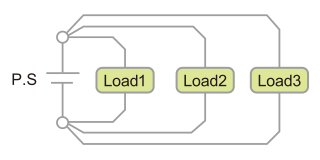
When connecting multiple loads, use a "star" connection pattern. Run separate wire pairs from the power supply terminals to each load.
Good
Proper Connection (Star Connection)
Incorrect
Daisy-Chain Connection
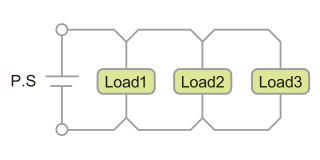
Note: In a daisy-chain configuration, Loads 2 and 3 will experience greater voltage drops. Ripple noise may also increase due to shared common impedance.
• Inductive Loads:
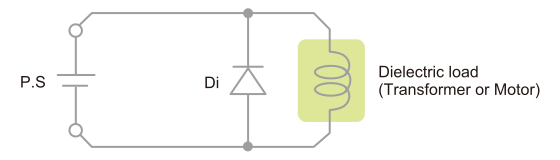
When connecting inductive loads (e.g., motors, solenoids, or coils), connect a protection diode (freewheeling diode) in parallel with the load. This protects the power supply from back EMF (inductive kickback) generated when the load is de-energized.
Rating Requirement: The diode's reverse voltage and forward current ratings must exceed the power supply's output voltage and current.
• Sparking or Capacitive Loads:
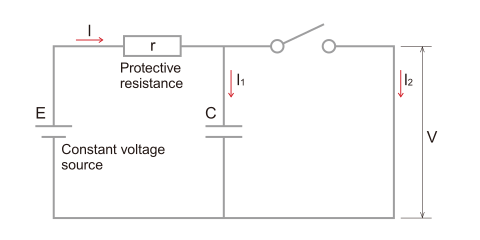
Loads that generate arcs, discharges, or short circuits (e.g., capacitor charging, vacuum discharge) can degrade the power supply's service life or cause failure. Install a current-limiting resistor in series with the output to protect the power supply.
In addition, to fully utilize the original performance of a DC power supply, it is important to properly connect and ground it.
Please also see the Technical Knowledge on our website, "Installation of DC Power Supply and remote sensing correctly and safely".
Please note: Failures or malfunctions caused by improper load connection are not covered under warranty.