



Understanding Constant Voltage (CV) and Constant Current (CC) Modes
A power supply is a device that supplies electrical energy to one or more electric loads. They are primarily of two types: voltage sources and current sources. In general, "power supply" often means a voltage source, but there are also current sources that supply constant current.
A power circuit that converts incoming electricity into the required form and outputs it is called a "power circuit." Power supply circuits can be roughly divided into "constant-voltage power supply" and "constant-current power supply."
Constant-voltage power supply
A constant-voltage power supply is a power circuit that controls the output voltage to a constant level. It always supplies a constant voltage regardless of the load and is widely used in power supplies for electronic circuits.
Most electronic circuits are designed to operate at a constant voltage because they cannot handle unexpected voltage fluctuations.
Constant-current power supply
A constant-current power supply is a power supply circuit that controls the output current to a constant level. Constant-current power supplies are used to power LED lighting and charge rechargeable batteries.
LED brightness is directly proportional to the current flowing through it. Any fluctuation in current results in brightness instability or flickering. Therefore, a constant current source is required to ensure stable illumination and protect the LED from overcurrent damage.
CC mode is also essential for charging rechargeable batteries. Since a battery's internal voltage rises as it charges, a constant voltage source could cause uncontrolled current spikes. A constant current supply ensures a controlled charging rate regardless of the battery's voltage level.
Conversion between the voltage source and current source
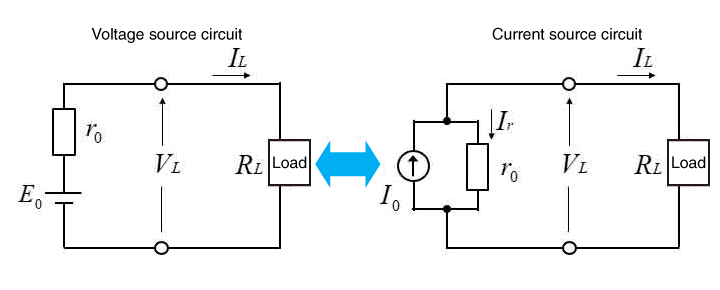
Voltage and current sources can be converted to each other equivalently. When the voltage applied to the load and the current flowing through the load are the same, the voltage source and the current source operate as having the same value and function.
In other words, a voltage source can be equivalently converted into a current source that does the same work for the load, and vice versa.
Programmable Multi-Mode Power Supplies
Advanced programmable DC power supplies offer flexible operation modes to suit various applications. Beyond standard Constant Voltage (CV) and Constant Current (CC) modes, these units may feature Constant Power (CP) and Constant Resistance (CR) modes, allowing for precise control depending on the load characteristics.
Principle of stabilization
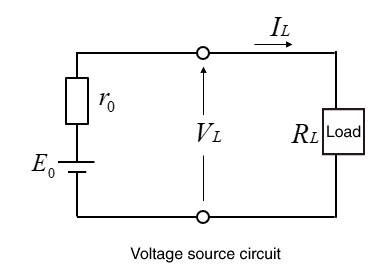
The circuit of a constant voltage source is shown below. A non-ideal voltage source is modeled as an ideal voltage source (E₀) in series with an internal resistance (r₀). The terminal voltage VL is expressed as follows:
r0 + RL
Therefore, when the internal resistance r0 is sufficiently small compared to the load resistance RL, VL≒E0. This results in a constant terminal voltage VL regardless of the load current IL.
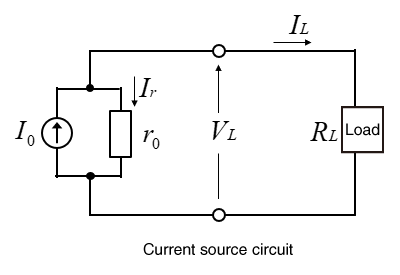
The circuit of a constant-current power supply is as shown below. The internal resistance of the constant-current power supply is in parallel with the power supply. The output current IL is expressed as follows:
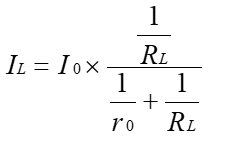
When the internal resistance r0 is ∞, IL≒I0. This makes the load current IL constant.
A power supply engineered to maintain constant output voltage or current despite load fluctuations is known as a Regulated DC Power Supply.
Regulated DC power supplies are generally categorized into two topologies: "Linear" (Series Regulator) and "Switching." Linear supplies offer low noise but lower efficiency, while switching supplies utilize high-frequency switching to achieve high efficiency and compact designs.
DC-regulated power supplies are broadly classified into "DC constant voltage power supplies" whose output voltage is stable even when the load changes and "DC constant current power supplies" whose output current is stable.
Programmable DC power supplies automatically switch to constant voltage (CV) mode or constant current (CC) mode, depending on the voltage and current settings and the load connected.
For more information on the merits and demerits of DC power supplies depending on the control method and the devices they handle, please refer to the links below.
Related Technical Articles
Recommended products
Matsusada Precision's DC power supplies are available in constant voltage power supplies (CV mode) and constant current power supplies (CC mode), depending on the setting.


