


There are two types of electricity: direct current and alternating current.
There are two types of electric current. These are direct current (DC) and alternating current (AC).
Direct current is a method in which electricity always flows in a certain direction, as compared to the flow of a river. It refers to the flow of electricity obtained from batteries, solar cells, etc.
On the other hand, alternating current (AC) is a method in which the positive and negative sides are constantly switched periodically and the direction of the flow of electricity changes accordingly. This is the flow of electricity obtained from a generator or outlet. The electricity produced at power plants and sent to homes is also transmitted as alternating current.
The diagram below shows the flow of DC and AC electricity.
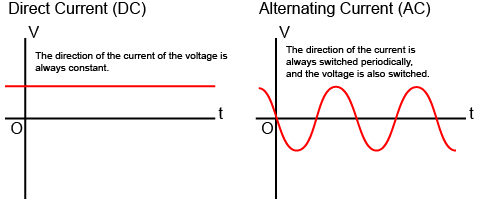
In direct current, the voltage is always constant, and the electricity flows in a certain direction. In contrast, in alternating current, the voltage periodically changes from positive to negative and from negative to positive, and the direction of the current also periodically changes accordingly.
Characteristics of DC power supply
Direct current (DC), characterized by its unidirectional flow, has the following advantages and disadvantages:
Advantages
- No phase shift (lead or lag) in steady-state circuits
- No reactive power is generated
- Can store electricity
Disadvantages
- Current interruption is difficult
- Difficult to convert voltage
- Strong electrolytic effect
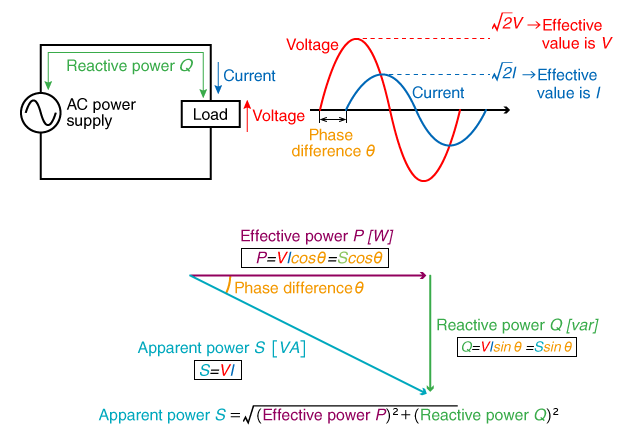
In AC circuits containing capacitors or inductors, the constantly changing current direction can lead to a phase difference (where the current either leads or lags the voltage.
However, in DC circuits, after an initial transient period, the constant voltage and current direction mean that capacitors act as open circuits and inductors act as short circuits. Thus, in steady-state DC, there is no ongoing phase shift.
In AC circuits with reactive components (like inductors or capacitors), energy is stored and released by these components, leading to power that oscillates between the source and the load without performing useful work. This is known as reactive power.
In DC circuits, once any capacitors are charged and inductor fields are established, current flows steadily through the resistive parts of the load. Therefore, no reactive power is generated in the steady state, allowing for efficient power delivery.
A key advantage of DC is its suitability for energy storage in devices such as primary batteries, rechargeable batteries, and capacitors.
DC also has disadvantages. Interrupting DC circuits, particularly at high voltages, can be challenging because the continuous voltage can sustain electrical arcs (sparks) when a circuit is broken. This can damage switchgear and pose safety risks.
AC is generally easier to interrupt because the voltage (and current) periodically passes through zero, providing natural opportunities to extinguish an arc and safely break the circuit.
Furthermore, changing DC voltage levels often requires conversion to AC, transformation, and then rectification back to DC. This makes DC-DC converters generally more complex and potentially larger and more expensive than AC transformers for equivalent power handling.
Another disadvantage of direct current is the severe corrosion of underground pipes and other metallic components required for power transmission. Since electricity always flows in the same direction in DC, corrosion of power transmission equipment increases due to electrolytic corrosion.
DC is supplied by energy storage devices like batteries and capacitors, making it the standard for most portable battery-powered electronics.
While household power is AC, most electronic devices, including computers and televisions, operate internally on DC. They use power adapters or internal power supplies to convert AC from the outlet into the various DC voltages they require (this process typically involves rectification, smoothing with capacitors, and voltage regulation).
In environments like data centers, where many devices consume DC power, there is a growing trend towards direct DC power distribution to reduce the energy losses associated with multiple AC-to-DC conversions.
Characteristics of AC power supply
AC, with its cyclic positive and negative voltage, has the following advantages and disadvantages.
Advantages
- Less power loss due to high voltage transmission
- Easy to transform
- Easy to shut down while power is flowing
- Polarity of connection is often not critical for simple AC loads
Disadvantages
- Peak voltage is higher than RMS voltage for the same effective power.
- Behavior is significantly influenced by reactive components like inductors and capacitors.
- Not suitable for ultra-long distance transmission
For long-distance power transmission (e.g., from power plants to urban areas), very high voltages (up to 600,000 V or higher) are used to improve efficiency. Power loss in transmission lines, mainly due to wire resistance, is proportional to the square of the current (P_loss=I2R).
This is because when the same current flows through a wire of the same resistance for the same period of time, the heat generated is proportional to the square of the current. Since this heat represents wasted energy, it is regarded as power loss.
For a given amount of transmitted power (P = VI), increasing the voltage (V) allows the current (I) to be reduced. For example, to transmit 3000 W, a 100 V system requires 30 A, whereas a 1000 V system requires only 3 A.
If the voltage is increased tenfold, the current is reduced to one-tenth, and consequently, the I2R power loss is reduced to one-hundredth. This dramatic reduction in loss is the main reason why high-voltage AC transmission is widely adopted.
These high transmission voltages are unsafe and unsuitable for direct use. Therefore, voltages are stepped down at substations: for example, to 100,000V for large industrial facilities, 6600V for commercial buildings, and finally to 200V or 100V for residential and office use.
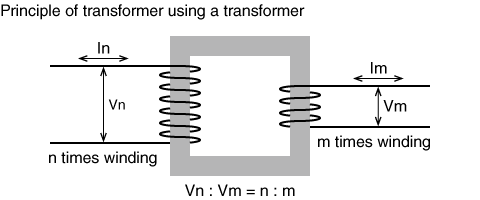
AC voltages can be easily and efficiently changed using transformers. This ease of voltage transformation is a major reason why AC is the standard for power distribution infrastructure, unlike DC which requires more complex converters.
As mentioned earlier, the periodic zero-crossing of AC voltage simplifies current interruption.
Additionally, for many AC devices, the polarity of connection to a power outlet is not critical, simplifying device connection (though proper wiring for safety, including grounding, is always essential).
A characteristic of AC is that its instantaneous voltage is constantly changing. For a sinusoidal AC waveform, the peak voltage is √2 (approximately 1.414) times its RMS (root mean square) or effective voltage. The RMS value is equivalent to the DC voltage that would produce the same heating effect in a resistor.
Therefore, insulation and equipment must be designed to withstand this higher peak voltage, not just the RMS value.
AC circuits are significantly influenced by reactive components like inductors (coils) and capacitors. These components store and release energy, causing phase shifts between voltage and current (current lagging voltage in inductors, current leading voltage in capacitors).
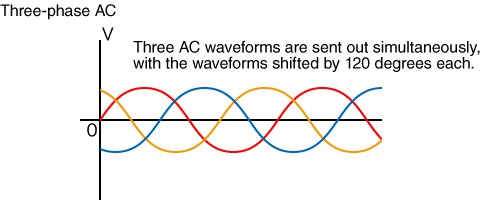
Power plants typically generate and transmit three-phase AC. This system involves three separate AC waveforms of the same frequency and amplitude, but phase-shifted from each other by 120 degrees. Three-phase power offers advantages for generating, transmitting, and powering large motors.
While three-phase AC is standard for high-voltage transmission and industrial applications, residential and most commercial outlets provide single-phase AC, derived from one of the three phases during voltage step-down.
Single-phase AC directly powers many simple appliances like vacuum cleaners and basic ventilation fans. However, for more sophisticated motor control in appliances like modern air conditioners, washing machines, and refrigerators, AC power is often converted (using inverters) to provide variable frequency and voltage for improved efficiency and performance.
Related Technical Articles
Recommended products
Matsusada Precision manufactures and sells a wide range of power supply equipment, including DC and AC power supplies, high-voltage power supplies, four-quadrant amplifiers, and electronic loads.


