


An actuator is a device that converts input energy or electrical signals into physical motion.
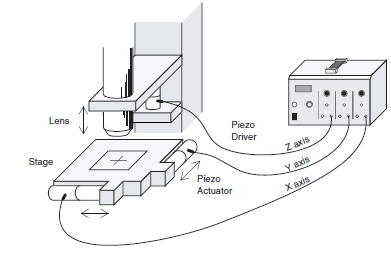
Matsusada Precision's piezo actuators utilize the inverse piezoelectric effect to achieve extremely precise displacement in the nanometer range.
What is Piezoelectric?
Piezoelectric materials exhibit two key effects: the direct piezoelectric effect, which generates an electric charge when mechanical force is applied, and the inverse piezoelectric effect, which generates mechanical strain when an electric field is applied. Piezo actuators utilize this inverse effect. Lead zirconate titanate (PZT) is a commonly used ceramic material for these elements.
Piezo Characteristics
Infinite Resolution
Piezo actuators operate by deforming a solid material rather than using mechanical parts like gears or bearings. This friction-free motion allows for smooth, continuous movement without threshold voltages. Consequently, the resolution is limited only by the noise and stability of the applied voltage driver, theoretically allowing for infinite resolution. Since the movement is based on solid-state deformation, there is no mechanical wear, ensuring high reliability even after millions of cycles.
High Stiffness and Force
Piezo actuators are ideal for positioning applications requiring sub-micron precision under heavy loads. High-performance stacked models can generate blocking forces of up to several tons, maintaining stability even in demanding environments.
Fast Responsiveness
Piezo actuators offer superior responsiveness compared to other actuator types. Since the expansion speed depends on the speed of sound within the ceramic material, they can achieve extremely high accelerations, making them suitable for high-speed scanning and switching applications.
General Piezo Characteristics
Hysteresis
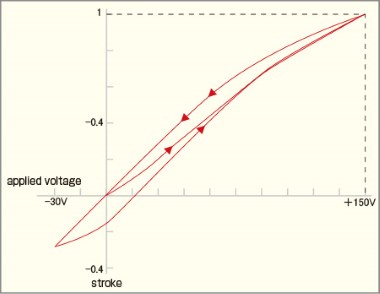
Piezo actuators exhibit hysteresis, meaning the displacement is not linearly proportional to the applied voltage. The expansion path differs depending on whether the voltage is increasing or decreasing, creating a nonlinear "hysteresis loop." The maximum difference can be approximately 10-15% of the full stroke. For applications requiring absolute position accuracy, a closed-loop control system with a position sensor (such as a strain gauge) is recommended.
Creep
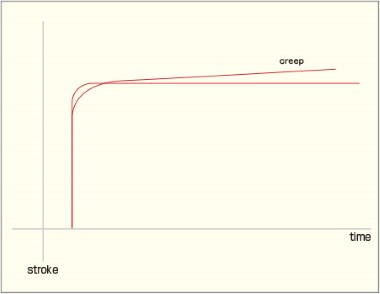
When a fixed voltage is applied to a piezo actuator, the displacement does not stabilize instantly but continues to change slightly over time. This phenomenon, known as creep, is caused by the delayed polarization of the ceramic material. The effect is logarithmic and stabilizes over time.
Handling Precautions
While Matsusada Precision piezo actuators are housed in robust cases, the internal ceramic elements are brittle and sensitive to certain forces. Careful handling during installation is essential.
Axial Load Only:
Stacked piezo actuators are designed to withstand compressive stress in the axial direction. Avoid applying lateral (shear) forces, bending moments, or tensile stress.
Torque Prevention:
For models with threaded tips, ensure that no rotational torque is applied to the piezo stack when attaching loads.
Parallel Mounting:
When installing the actuator between two surfaces, ensure the surfaces are perfectly parallel and perpendicular to the actuator axis. If parallelism cannot be guaranteed, use an actuator with a ball tip to decouple lateral forces.
Preload Mechanisms:
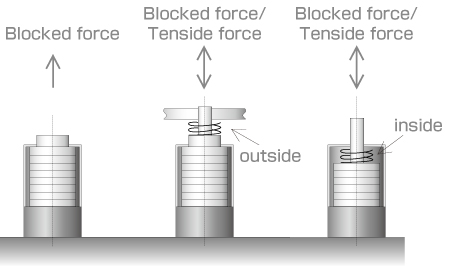
Models with an integrated preload mechanism (casing with internal spring) are recommended, as they protect the piezo element from tensile forces and slight misalignments.
Related Technical Articles
Recommended products
Matsusada Precision provides precision control solutions with piezo actuators and piezo drivers.


