


What is a DC Power Supply?
A DC power supply is a device that converts Alternating Current (AC) from a wall outlet into stable Direct Current (DC). It is an essential tool for powering electronic circuits and testing devices.
Standard household outlets provide AC power (e.g., 100V-240V). However, AC voltage often fluctuates due to transmission losses or changes in power consumption by other connected devices.
While minor voltage fluctuations may not affect simple appliances like fans or vacuum cleaners, precision electronic equipment can malfunction due to even slight changes in voltage. Furthermore, since most electronic circuits require DC to operate, the supplied AC must be converted into a clean, stable DC output.
A "stabilized DC power supply" is designed to perform this conversion and regulation precisely.
Stabilized DC power supplies operate in two primary modes: Constant Voltage (CV), where the output voltage is kept constant regardless of load changes, and Constant Current (CC), where the output current is maintained at a set level.
For more details on these modes, please refer to the article below.
Constant Voltage (CV) vs Constant Current (CC) Power Supplies
Points to consider when selecting a DC stabilized power supply
When selecting a DC stabilized power supply, there are two main points to consider: output range and circuit method.
Output Range: Single-Range vs. Wide-Range
The output range is a critical factor when selecting a power supply. Models are generally categorized as either "single-range" or "wide-range" (auto-ranging).
Single-Range Power Supplies
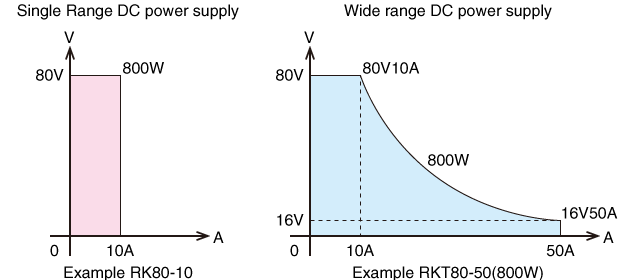
In a single-range power supply, the maximum output power is determined by the rated voltage and rated current. For example, a model rated at 80V / 10A (800W) can output up to 80V and up to 10A. However, it can only achieve maximum power (800W) at that specific maximum voltage and current point.
Wide-Range (Turbo) Power Supplies
A wide-range power supply offers greater flexibility by maintaining its rated power across a broader combination of voltage and current settings. Using the example of a Matsusada Precision model rated at 80V / 50A (800W):
- At the maximum voltage of 80V, the current is automatically limited to 10A to maintain the 800W limit.
- At the maximum current of 50A, the voltage limits to 16V.
This capability allows a single wide-range unit to cover the operating regions of multiple single-range power supplies.
Which should you choose?
If your application requires testing at fixed voltage and current levels, a single-range power supply is a cost-effective choice. However, for testing motors, conducting battery charge/discharge cycles, or evaluating components that require high current at low voltages, a wide-range power supply is ideal. It saves both cost and installation space by reducing the number of power supply units required.
Circuit Topology: Linear vs. Switching
There are two primary circuit methods used in DC power supplies: the Linear method (Series Regulator) and the Switching method.
Linear Method (Series Regulator)
The Linear method converts AC to DC using a transformer and regulates the output using semiconductors.
Advantages: Extremely low noise (ripple) and excellent transient response.
Disadvantages: Larger physical size, heavier weight, and higher heat generation compared to switching models.
Switching Method
The Switching method converts AC to DC, then switches the current at high frequencies using semiconductors to regulate the output efficiently.
Advantages: Compact, lightweight, and highly efficient.
Disadvantages: The switching mechanism can generate slight high-frequency noise.
Selection Guide
While older linear power supplies were often bulky and heavy, modern switching power supplies have become the industry standard due to their compact form factor and efficiency. However, for applications requiring ultra-low noise--such as sensitive analog circuit testing or scientific research--a Linear power supply remains the best choice.
When selecting a power supply, consider whether your priority is size/efficiency (Switching) or ultra-low noise performance (Linear).
Guidelines for replacing a DC power supply
As wide-range power supplies have been widely used in recent years, the performance and functions of DC-regulated power supplies are advancing day by day.
Therefore, even if there are no particular problems with the DC stabilized power supply you are currently using, it is worth considering a new power supply if you have any of the following points.
- Large and requires a large space for installation
- Heavy, making it difficult to move
- Low efficiency and high power consumption
- Generates a lot of heat and the cooling fan is noisy.
- No meter or analog meter, so it takes time to read the values.
- Cannot be controlled remotely
- Analog control takes time to set and adjust.
The problems of size, weight, efficiency, and heat generation can be solved by changing the dropper-type power supply to a switching type. Also, in recent years, the user interface has dramatically improved with meters and remote control, making power supplies easier for everyone to use. Therefore, if you feel that your power supply is getting old, you may want to select a new power supply.
Guidelines for replacing a DC power supply
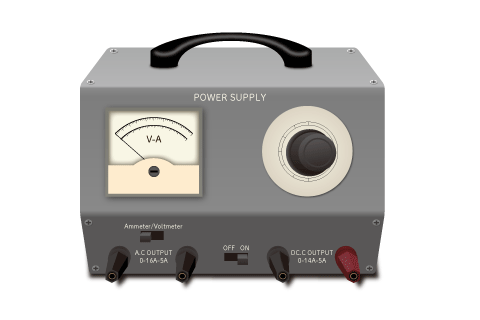
Old DC power supplies are
- Large and heavy (bulky and difficult to move)
- Low efficiency (high power consumption)
- High heat generation (noisy fan)
- No meter or analog meter
- No remote control
- Analog control takes time for setting and adjustment
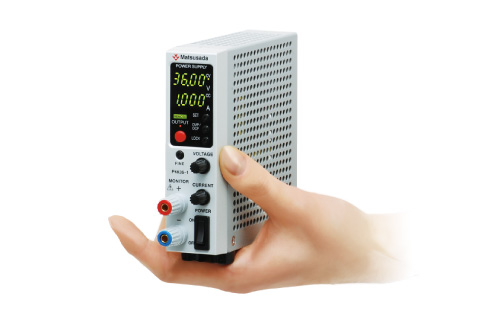
The latest DC power supplies are
- Compact and lightweight
- High efficiency
- Low heat generation
- Easy to set and adjust with digital control
- Remote control is possible
Precautions for using DC power supplies
So, what points should we pay attention to when using a DC-regulated power supply? Basically, regardless of whether the DC-regulated power supply is a dropper type or a switching type, it is important to ensure heat dissipation when using it. Using a power supply in a dusty place can also shorten its life.
In addition, check each point for trouble when using the product, depending on the situation.
If the unit does not start up properly the first time it is energized, the overcurrent protection may be activated. In this case, review the current setting of the DC power supply. It is a good idea to re-examine the current of the power supply, taking into account the inrush current flowing at the start-up of the load side.
If the input breaker tripped or the external fuse blew, the inrush current may have affected the system. In general, the inrush current of a regulated DC power supply flows several times to several tens of times higher than normal when energized. Recheck the inrush current of each regulated DC power supply and the specifications of the breakers and fuses.
If the problem persists after checking, contact the manufacturer's support desk. DC power supplies and other power supply-related devices can lead to serious problems if they break down, making it impossible for other devices to operate. It is best to choose a product from a manufacturer that is quick to respond and provides detailed support.
Related Technical Articles
Recommended products
Matsusada Precision's high-performance DC power supplies


