


Parallel operation is a method of connecting the outputs of multiple power supplies with the same voltage rating to increase the total available current. This configuration allows for scaling up power capacity to meet high-current requirements beyond the limit of a single unit. The total output current, It, is the sum of the currents from the individual units:
where I1 through In represent the current supplied by each power supply.
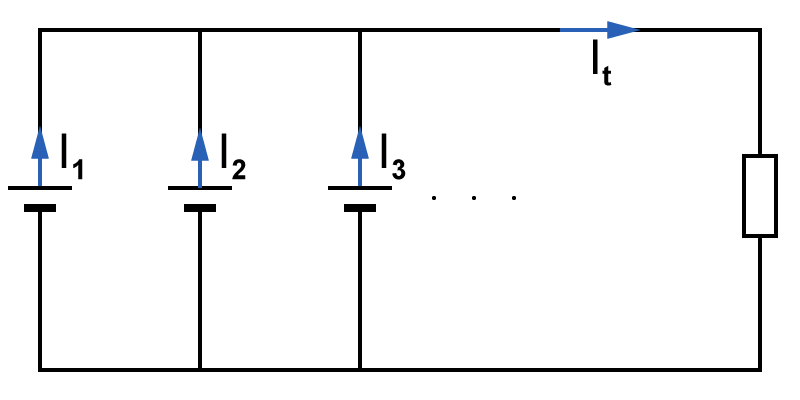
Current Balancing and Master-Slave Control
Simply connecting power supplies in parallel can be risky. Even minor differences in output voltage settings or internal impedance can cause a current imbalance, where one unit carries a disproportionate load or "circulating currents" flow between units. This can lead to overheating or protection faults.
To ensure safe operation, the load current must be shared equally among all units. Modern industrial power supplies typically use Master-Slave operation (active current sharing). In this configuration, one "Master" unit controls the voltage and communicates with the "Slave" units to ensure they output the exact same current, providing stable and efficient power without the need for external balancing resistors.
- Typical Applications
- Parallel operation is essential for applications requiring high current capacity:
- Electroplating: Processes requiring stable DC currents of hundreds or thousands of amperes.
- Laser Drivers: High-power laser diodes and cluster drives.
- Aging and Burn-in Testing: Semiconductor and component testing requiring scalable power.
- Water Treatment & Electrolysis: Industrial electrochemical processes.
- Key Engineering Considerations
- Master-Slave Functionality: Using power supplies with built-in parallel control capability is recommended for reliability. This eliminates the need for complex external control circuits.
- Wiring Symmetry: To prevent voltage drops from affecting current balance, load cables should be of equal length and gauge for each power supply before the common connection point.
- Remote Sensing: When operating in parallel, correct sensing wiring is crucial to compensate for voltage drops across the high-current bus bars or cables.