


Efficiency represents the ratio of useful output power to total input power. It is a critical performance indicator for electrical equipment, including transformers, motors, and power supplies. Efficiency is generally derived using one of two methods: direct efficiency, calculated by measuring input and output power directly, or conventional efficiency, estimated by summing individual component losses.
For power supply units, such as switching power supplies and high-voltage power supplies, efficiency is typically determined through direct measurement of the input and output power at the rated output.
In power supplies, energy losses occur due to factors such as the ON-resistance of switching devices, diode losses, transformer winding resistance, magnetic core hysteresis, and power consumed by internal control circuits. While efficiency is often specified at the rated output, the actual efficiency varies depending on the load conditions. Generally, efficiency decreases at lighter loads as fixed losses become a larger proportion of the total power consumption.
Calculation Example:
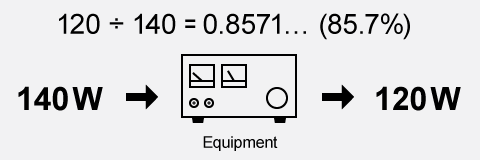
Consider a power supply with a rated output of 12 V and 10 A (120 W output power) that consumes 140 W of input power. The efficiency is calculated as follows:
Efficiency (%) = (Output Power / Input Power) × 100
Efficiency = 120 W / 140 W ≈ 0.857
Result: 85.7%
The table below details typical loss factors specifically within transformers, which are key components in determining overall power supply efficiency.
| Losses | No-load losses | Iron or Core losses | Hysteresis losses |
|---|---|---|---|
| Eddy current losses | |||
| Load losses | Copper losses | ||
| Stray losses | |||
Related Technical Articles
- What is a Power Supply? Types and Applications
- What is a Power Supply? (Basic Knowledge)
- Safety and Usage of High Voltage Power Supply
- An Introduction to DC Power Supplies
- What is a Bipolar Power Supply? (Basic Knowledge)
- Electronic Loads: An Introduction to Principles, Types, and Uses
- What is an AC Power Source? - Basic Knowledge -
- Linear vs. Switching Power Supplies: Key Differences Explained
- Types of X-ray Tubes and High-voltage Power Supplies
- High Voltage Measurement Method
- How to Choose a DC Power Supply: Key Points to Consider
- Difference between DC power and AC power
- A Beginner's Guide to Using Power Supplies Safely
- A Guide to Using DC Power Supplies Correctly and Safely
- HVPS for Lab Analyzers: Key Considerations for Stability and Noise
- Amplifier Basics: Principles, Operation, and Key Considerations
- Method of Generating Direct Current (DC) Power