


A "rating" defines the specified operating limits and performance guarantees of a device under defined conditions. For power supplies, primary ratings typically include input/output voltage, current, frequency, and total power. Specifications may also distinguish between different operating modes, such as continuous ratings, short-time ratings, and absolute maximum ratings.
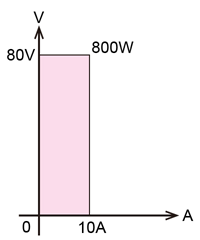
For example, consider the RKT80-50 (800 W) regulated power supply. It has a rated voltage of 80 V, a rated current of 50 A, and a maximum output power of 800 W. Due to the power limit, the unit cannot output maximum voltage and maximum current simultaneously.
When outputting the rated 80 V, the available current is limited to 10 A (800 W / 80 V = 10 A). Conversely, to utilize the full rated current of 50 A, the output voltage operates up to 16 V (800 W / 50 A = 16 V).
Related Technical Articles
- What is a Power Supply? Types and Applications
- What is a Power Supply? (Basic Knowledge)
- Safety and Usage of High Voltage Power Supply
- An Introduction to DC Power Supplies
- What is a Bipolar Power Supply? (Basic Knowledge)
- Electronic Loads: An Introduction to Principles, Types, and Uses
- What is an AC Power Source? - Basic Knowledge -
- Linear vs. Switching Power Supplies: Key Differences Explained
- Types of X-ray Tubes and High-voltage Power Supplies
- High Voltage Measurement Method
- How to Choose a DC Power Supply: Key Points to Consider
- Difference between DC power and AC power
- A Beginner's Guide to Using Power Supplies Safely
- A Guide to Using DC Power Supplies Correctly and Safely
- HVPS for Lab Analyzers: Key Considerations for Stability and Noise
- Amplifier Basics: Principles, Operation, and Key Considerations
- Method of Generating Direct Current (DC) Power