


Input current refers to the electrical current a power supply draws from its source. For AC-input power supplies, this value is typically specified in Root Mean Square (RMS).
Many power supplies without a Power Factor Correction (PFC) circuit utilize a capacitive input rectifier. This design draws current in short pulses only near the peaks of the AC voltage, resulting in a non-sinusoidal waveform as shown in the figure.
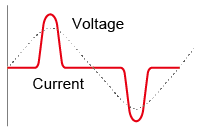
The approximate RMS input current can be calculated using the following formula:
Input Current (RMS) = Output Power / (Input Voltage × Efficiency × Power Factor)
For power supplies without a PFC circuit, the power factor is typically low (0.5-0.7). In contrast, models equipped with an active PFC circuit are designed to draw a sinusoidal input current in phase with the input voltage. This ensures a high power factor (close to 1.0) and more efficient power utilization from the AC line.
Related Technical Articles
- What is a Power Supply? Types and Applications
- What is a Power Supply? (Basic Knowledge)
- Safety and Usage of High Voltage Power Supply
- An Introduction to DC Power Supplies
- What is a Bipolar Power Supply? (Basic Knowledge)
- Electronic Loads: An Introduction to Principles, Types, and Uses
- What is an AC Power Source? - Basic Knowledge -
- Linear vs. Switching Power Supplies: Key Differences Explained
- Types of X-ray Tubes and High-voltage Power Supplies
- High Voltage Measurement Method
- How to Choose a DC Power Supply: Key Points to Consider
- Difference between DC power and AC power
- A Beginner's Guide to Using Power Supplies Safely
- A Guide to Using DC Power Supplies Correctly and Safely
- HVPS for Lab Analyzers: Key Considerations for Stability and Noise
- Amplifier Basics: Principles, Operation, and Key Considerations
- Method of Generating Direct Current (DC) Power