


Precision - Repeatability of the Output
Precision refers to the closeness of agreement between multiple measurements conducted under the same conditions. It is a measure of the "repeatability" or "consistency" of the output, indicating how small the random variations are. In short, it signifies the ability to produce the same result repeatedly.
Precision in DC Power Supplies
For DC power supplies, precision represents the consistency of the output values when the same voltage or current is set multiple times. High precision ensures that the power supply delivers the same output level every time it is activated, minimizing random variations.
Why Precision Matters
High precision is crucial for reliable experimental results. In sensitive research and industrial applications, even minor fluctuations or lack of repeatability can significantly impact outcomes. A precise power supply ensures that data remains consistent across multiple test runs.
Distinguishing Precision from Accuracy
It is critical to distinguish precision from accuracy, as they define different aspects of performance.
- Precision: The closeness of multiple measurements to each other (Repeatability).
- Accuracy: The closeness of a measurement to the true or target value (Correctness).
In power supply datasheets, accuracy is typically the primary performance guarantee (e.g., ±(X% + YmV)). This specification defines the maximum deviation from the setpoint.
While precision is rarely listed as a standalone specification, it is an inherent factor in overall system performance. A unit with high accuracy specifications generally incorporates the necessary precision to maintain output within the guaranteed error margin.
Visualizing Accuracy vs. Precision
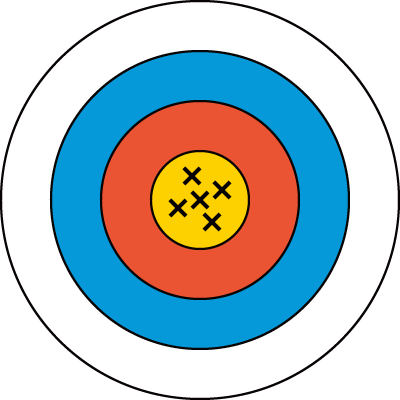
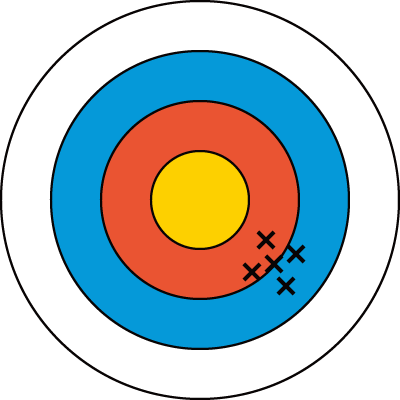
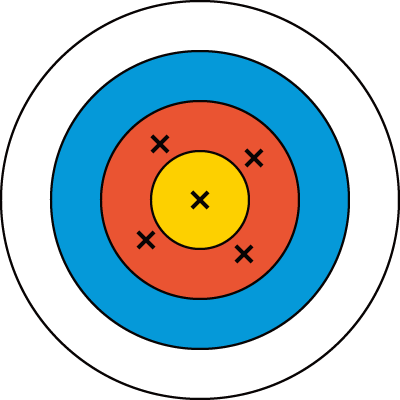
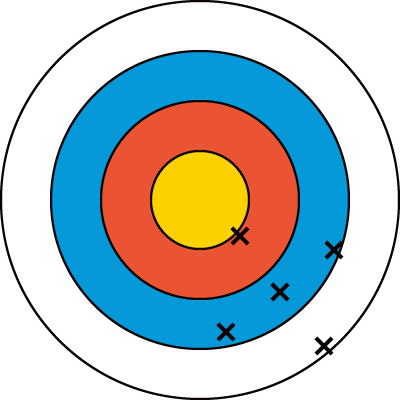
The target analogy provides an intuitive way to understand the relationship between accuracy and precision.
| High Accuracy & High Precision | Low Accuracy & High Precision | High Accuracy & Low Precision | Low Accuracy & Low Precision |
|---|---|---|---|
| Shots are tightly grouped in the center. The output is both correct and repeatable. This is the ideal state. | Shots are tightly grouped but off-center. The output is repeatable (high precision) but incorrect (low accuracy), indicating a systematic error. | Shots are scattered, but the average position is centered. The output is roughly correct on average (high accuracy) but lacks repeatability (low precision). | Shots are widely scattered and off-center. The output is neither correct nor repeatable. |
|
|
|
|