


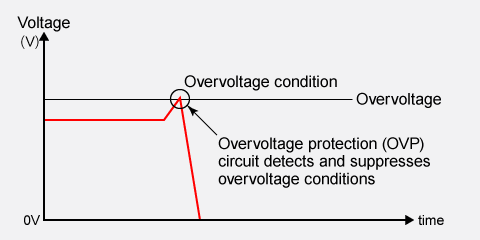
Overvoltage Protection (OVP) is a critical safety feature that protects both the power supply and the connected load. It functions by shutting down the output or clamping the voltage if it exceeds a preset safety threshold.
Overvoltage can occur on either the input or output side. Input-side surges are typically caused by external events, such as lightning strikes or power line fluctuations. Output-side overvoltage, however, usually results from an internal failure in the power supply's regulation circuit or an external voltage being applied to the output terminals.
Without effective OVP, excessive voltage can destroy sensitive electronic components, including ICs, capacitors, and resistors. In severe cases, this can lead to overheating or fire hazards. Therefore, OVP is an essential specification for ensuring the reliability and safety of electronic systems.
OVP is implemented using various circuit techniques. Common methods include using a comparator IC to monitor voltage and trigger a shutdown (crowbar or latch-off), or employing components like Zener diodes or Transient Voltage Suppression (TVS) diodes to clamp the voltage at a safe level.
Matsusada Precision prioritizes safety in design. We incorporate robust Overvoltage Protection (OVP) across a wide range of our power supply products to safeguard your critical equipment.
FAQ: What is the response time of the protection functions?
Related Technical Articles
- What is a Power Supply? Types and Applications
- What is a Power Supply? (Basic Knowledge)
- Safety and Usage of High Voltage Power Supply
- An Introduction to DC Power Supplies
- What is a Bipolar Power Supply? (Basic Knowledge)
- Electronic Loads: An Introduction to Principles, Types, and Uses
- What is an AC Power Source? - Basic Knowledge -
- Linear vs. Switching Power Supplies: Key Differences Explained
- Types of X-ray Tubes and High-voltage Power Supplies
- High Voltage Measurement Method
- How to Choose a DC Power Supply: Key Points to Consider
- Difference between DC power and AC power
- A Beginner's Guide to Using Power Supplies Safely
- A Guide to Using DC Power Supplies Correctly and Safely
- HVPS for Lab Analyzers: Key Considerations for Stability and Noise
- Amplifier Basics: Principles, Operation, and Key Considerations
- Method of Generating Direct Current (DC) Power