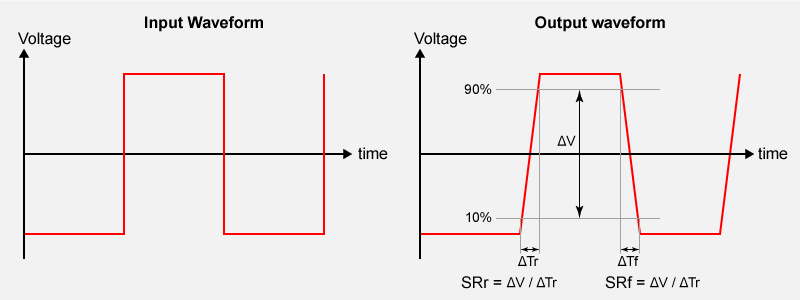

Slew rate is defined as the maximum rate at which the output voltage of a power supply or amplifier can change in response to a step change in the input signal. It is typically expressed in units of voltage per unit of time (e.g., V/µs or V/s).
For high-voltage amplifiers, slew rate is a critical performance indicator representing how quickly the output can transition between voltage levels. A higher slew rate allows the amplifier to accurately reproduce fast-changing input signals without distortion.
Impact on Waveforms
Ideally, when a square wave pulse is input, the amplifier should output an identical square wave. In reality, the slew rate limits the speed of the voltage transition. This causes the vertical edges of the output waveform to slope, resulting in a trapezoidal shape. The steepness of this slope corresponds to the slew rate.
Specifications typically define the slew rate based on the slower of the rising (ramp-up) or falling (ramp-down) speeds.
Example Calculation
Consider a high-voltage amplifier outputting a signal that steps from 0 V to 10 kV. If the amplifier has a slew rate of 10,000 V/s, the rise time will be 1 second. Applications requiring faster response times necessitate a model with a higher slew rate.