


Leakage current is the electric current that flows through protective insulation, capacitors, or other components to the ground or chassis, bypassing the intended circuit path. In the context of power supplies, managing leakage current is critical for ensuring safety and regulatory compliance.
Leakage current can be categorized into three main types based on its source and nature:
- Component-level leakage: Minute currents inherent to electronic components, such as semiconductors or capacitors. While these currents are intrinsic and generally unavoidable, they are typically negligible in standard operation.
- Operational leakage current (Protective conductor current): Current that flows from the device to the protective earth ground during normal operation. This is primarily caused by the Y-capacitors in EMI (Electromagnetic Interference) filters. Safety standards strictly limit this current to prevent electric shock hazards if the ground connection is lost.
- Fault current: A significant and dangerous current flow resulting from insulation failure, short circuits, or ground faults. Unlike the small, expected operational leakage, fault current poses an immediate risk of severe damage or injury.
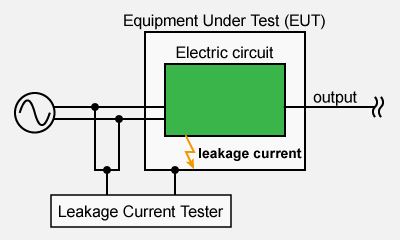
In AC-DC power supplies, operational leakage current is the primary concern for system integrators. It largely originates from the EMI filter, where Y-capacitors are used to shunt high-frequency noise to the ground. While these capacitors are essential for electromagnetic compatibility (EMC), they create a path for a small amount of AC current to leak to the earth ground.
For manufacturers and users of industrial equipment, "leakage current" typically refers to this operational leakage. Since excessive leakage can cause safety breakers (ELCB/RCD) to trip or pose safety risks, it must be measured accurately. Measurement methods, often defined by standards such as IEC 60990, use specific networks to simulate human body impedance and determine the potential current flow.
Related Technical Articles
- What is a Power Supply? Types and Applications
- What is a Power Supply? (Basic Knowledge)
- Safety and Usage of High Voltage Power Supply
- An Introduction to DC Power Supplies
- What is a Bipolar Power Supply? (Basic Knowledge)
- Electronic Loads: An Introduction to Principles, Types, and Uses
- What is an AC Power Source? - Basic Knowledge -
- Linear vs. Switching Power Supplies: Key Differences Explained
- Types of X-ray Tubes and High-voltage Power Supplies
- High Voltage Measurement Method
- How to Choose a DC Power Supply: Key Points to Consider
- Difference between DC power and AC power
- A Beginner's Guide to Using Power Supplies Safely
- A Guide to Using DC Power Supplies Correctly and Safely
- HVPS for Lab Analyzers: Key Considerations for Stability and Noise
- Amplifier Basics: Principles, Operation, and Key Considerations
- Method of Generating Direct Current (DC) Power